Wet the pads
Water is circulated from the tank to saturate the evaporative cooling pads.

 RTFANS product reference
Cooling Pads System / Product record
publishedComplete evaporative cooling pad system for greenhouse, poultry, livestock and industrial ventilation applications, with water circulation and installation components configured to project requirements.
Product overview
Product record
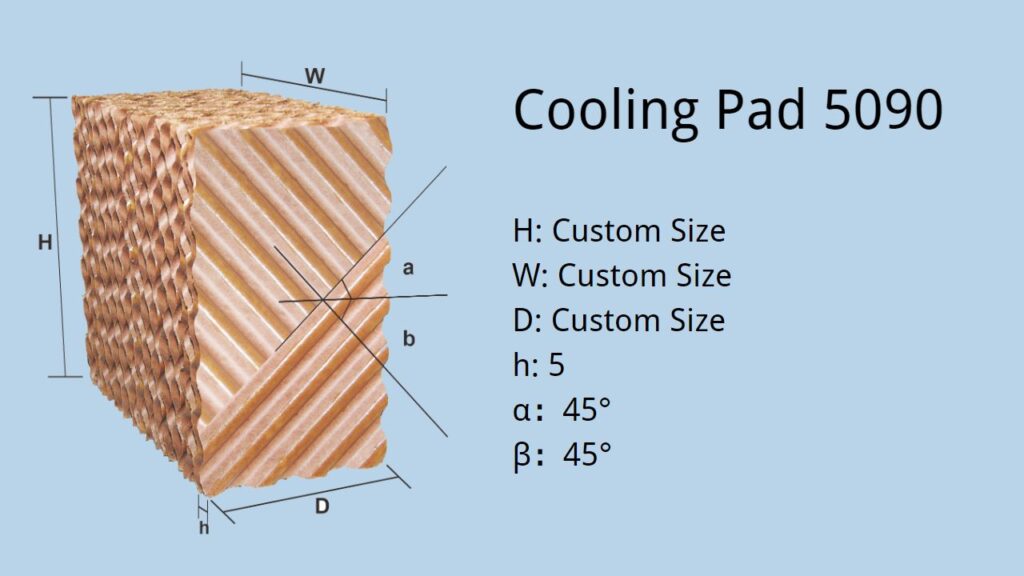
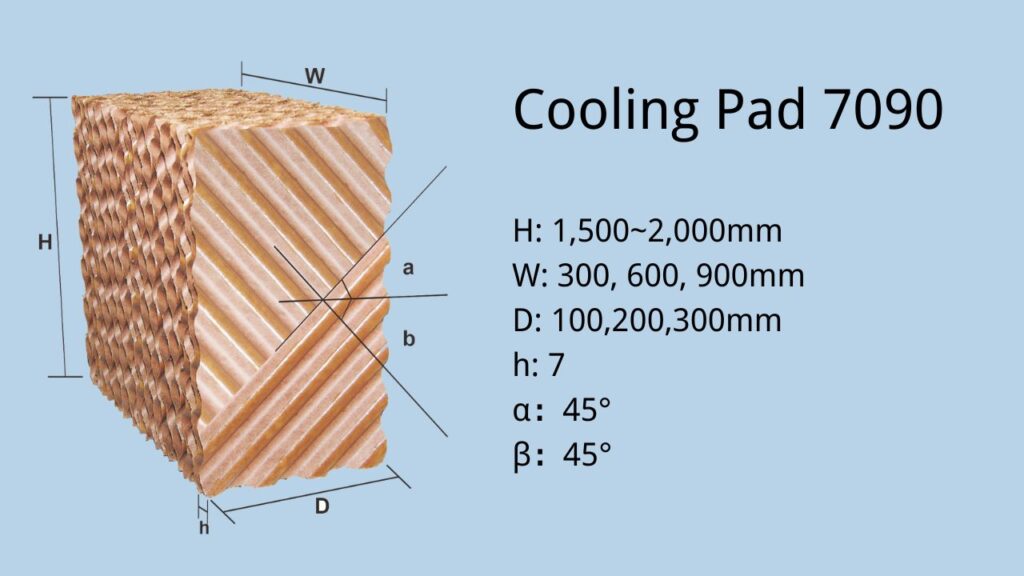
| MPN | KA-5090 / KA-7090 |
|---|---|
| SKU | KA5090LL1 / KA7090LL1 |
| Pad Height(mm) | As per Requirement / 1,500, 1,800, 2,000 |
| Pad Width(mm) | As per Requirement / 300, 600, 900 |
| Pad Depth(mm) | 50, 150, 200 / 100, 150, 200, 300 |
| Flute Height(mm) | 5 / 7 |
| Groove Angle a | 45° / 45° |
| Groove Angle b | 45° / 45° |
Product context
Evaporative Cooling Pad System is designed for large factories, warehouses and high-heat industrial spaces. Its treated evaporative media supports stable water distribution and heat transfer.
Operating principle
Water is circulated from the tank to saturate the evaporative cooling pads.
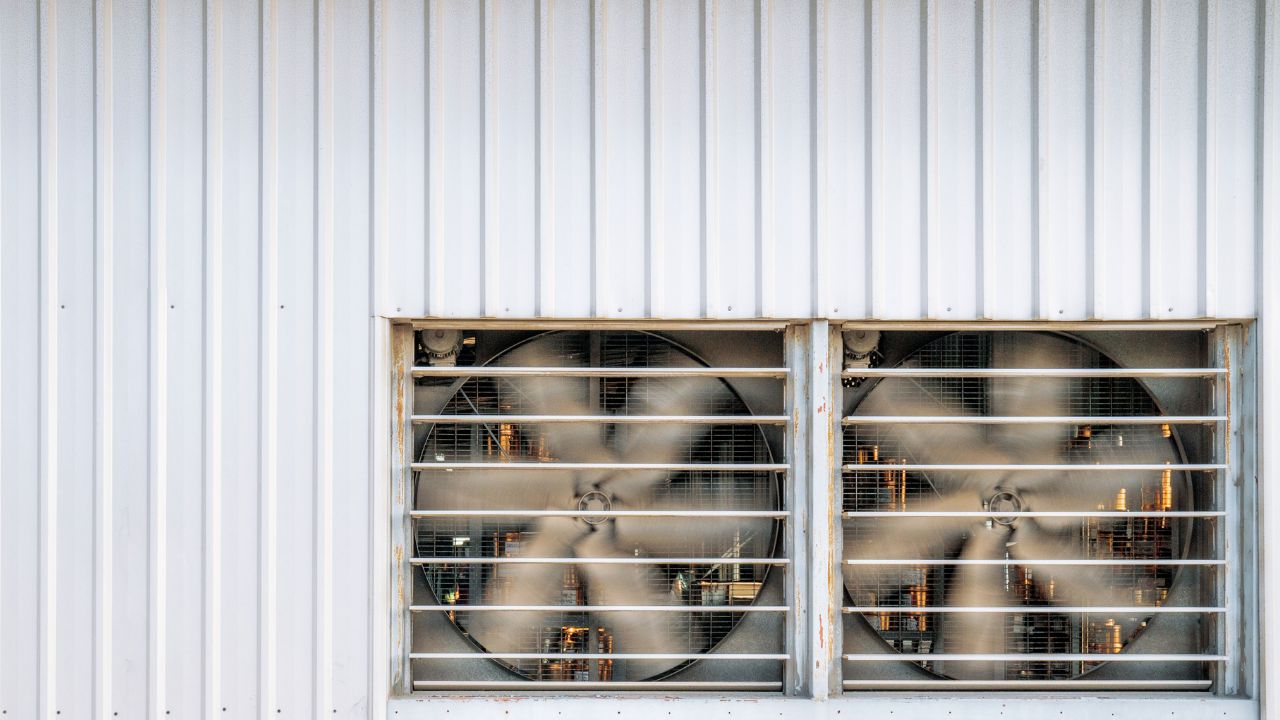
The fan or blower pulls hot outdoor air through the wet pads.
Heat is absorbed through evaporation before filtered air reaches the occupied space.
Built for industrial use
Continuous outdoor air movement helps reduce heat in open or semi-open facilities.
Even wetting supports stable evaporation, filtration and cooling performance.
Corrosion-resistant housing and reinforced components support long service life.
Timer, temperature and optional humidity controls make daily operation easier.
Selection data
Before specifying
Cooling performance depends on entering air temperature, relative humidity and ventilation. The system performs best where cooled fresh air can move continuously through the space.
Service routine
Before seasonal shutdownTurn off the water supply, empty and clean the tank, and dry the cooling pads.
During extended storageDrain circulating water and check the tank, pads and housing for scale, algae or corrosion.
Facility planning
Review pad construction, water distribution, installation pairing and service requirements for this cooling media system.
RTFANS supplies evaporative cooling pad systems designed for agricultural, greenhouse, livestock and industrial ventilation applications. A complete system combines evaporative cooling media with the required water circulation and installation components to create a continuous wetted surface. When ventilation fans draw warm outside air through the wet cooling pads, water evaporation absorbs heat from the incoming air before it enters the building. Send us your building dimensions, application and required cooling pad size for system configuration and quotation.
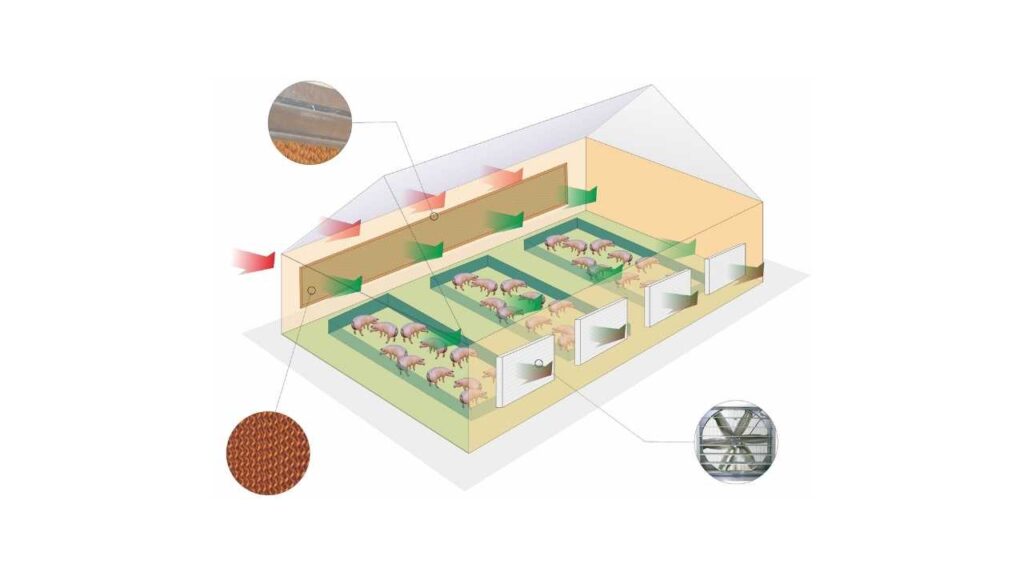
Water is circulated across the cooling pad media to maintain a wetted surface. Ventilation or exhaust fans create airflow through the pads, drawing warm outside air across the wet media. As part of the circulating water evaporates, heat is absorbed from the incoming air. The cooled air then enters the building while the ventilation system maintains continuous airflow.
Depending on the project design, a complete system can include evaporative cooling pads, a supporting frame, water distribution components, water collection and return components, a circulation pump and associated piping. The water distribution section supplies water across the top of the pads, while the collection section returns water to the circulation system. Frame dimensions are configured according to the required cooling pad area and installation opening.
In greenhouse applications, cooling pads can be installed on one side while exhaust fans are positioned on the opposite side to create negative pressure. Cooling pads can also form part of tunnel ventilation systems for poultry buildings and suitable livestock facilities. For factories, workshops and other industrial facilities, the system should be designed around airflow requirements, climate conditions, building dimensions and the required ventilation arrangement.
System performance depends on building dimensions, required ventilation rate, cooling pad area, cooling pad model and depth, exhaust fan capacity, air velocity, water circulation, water distribution, installation arrangement and local temperature and humidity. Cooling pads and exhaust fans should therefore be considered as parts of the same ventilation system rather than isolated components.
RTFANS offers KA-5090 with a 5 mm flute structure and KA-7090 with a 7 mm flute structure. Both use 45° / 45° flute angles and evaporative cooling. Neither model is universally better; selection should be based on airflow, air velocity, pressure drop requirements, cooling pad depth, equipment design and installation dimensions.
For a system quotation, provide the application, building size, cooling pad opening, pad thickness, required airflow, number and capacity of exhaust fans, summer outdoor temperature, relative humidity, power supply and destination country. If some technical information is not available, send your building dimensions, application and destination as a starting point.
RTFANS supports cooling pad and ventilation requirements as part of an overall system configuration. The 5090 and 7090 media options, project-based dimensions and agricultural and industrial application experience help distributors, equipment manufacturers and project contractors discuss a suitable supply configuration.
A cooling pad system uses wetted media and controlled airflow. Water is circulated through the pads while ventilation fans draw warm outside air through the wet media. A fan-and-pad system combines cooling pads with mechanical ventilation, typically using inlet pads and exhaust fans to create negative pressure. The required cooling pad area depends on system airflow and design air velocity. Actual cooling performance depends on outdoor dry-bulb temperature, relative humidity, media characteristics, airflow and system design, so a fixed temperature reduction should not be promised without defined operating conditions.
Planning a greenhouse, poultry house, livestock or industrial evaporative cooling project? Send your application, building dimensions, cooling pad dimensions, required airflow, exhaust fan information, outdoor temperature and humidity, and destination country. Drawings or technical specifications can also help identify the required system configuration.
Related industrial equipment
Facility planning
Engineering selection support
Share floor area, clear height, roof structure, and operating conditions for a project-specific recommendation.